


Precipitated Barium Sulfate in Coatings: Why Mesh Count Is Not Enough — D50, D90 and Span Explained
Leave a message
Precipitated Barium Sulfate in Coatings: Why Mesh Count Is Not Enough - D50, D90 and Span Explained
Meta description:** Precipitated barium sulfate is specified in "mesh" too often - and mesh hides the particle size distribution that actually controls gloss, settling, filtration and film defects. This guide explains why D50, D90, D10 and Span should replace mesh count in every coatings specification.
The Question Every Coatings Formulator Should Ask
Ask a coatings technologist why a barium sulfate grade was selected and the answer is often "1250 mesh" or "superfine". Ask what the particle size distribution actually looks like - the median, the coarse tail, the width - and the answer usually turns vague. That gap is not cosmetic. In high-gloss topcoats, thin-film systems and storage-sensitive formulations, the coarse tail of the distribution decides whether a coating performs or fails, while the mesh number says almost nothing about it.
This article walks through the problem in the order a formulator meets it: what mesh count really measures, why it breaks down in the fine-particle range, what D50, D90, D10 and Span add, and how each one links to a specific coating property. It is based on a technical explainer video on precipitated barium sulfate selection produced by the coatings technical account CoatingAIPro, with the support of Yunfu Hongzhi New Materials, a specialty precipitated barium sulfate manufacturer (Yunfu, China).
What Mesh Count Actually Tells You - and What It Hides
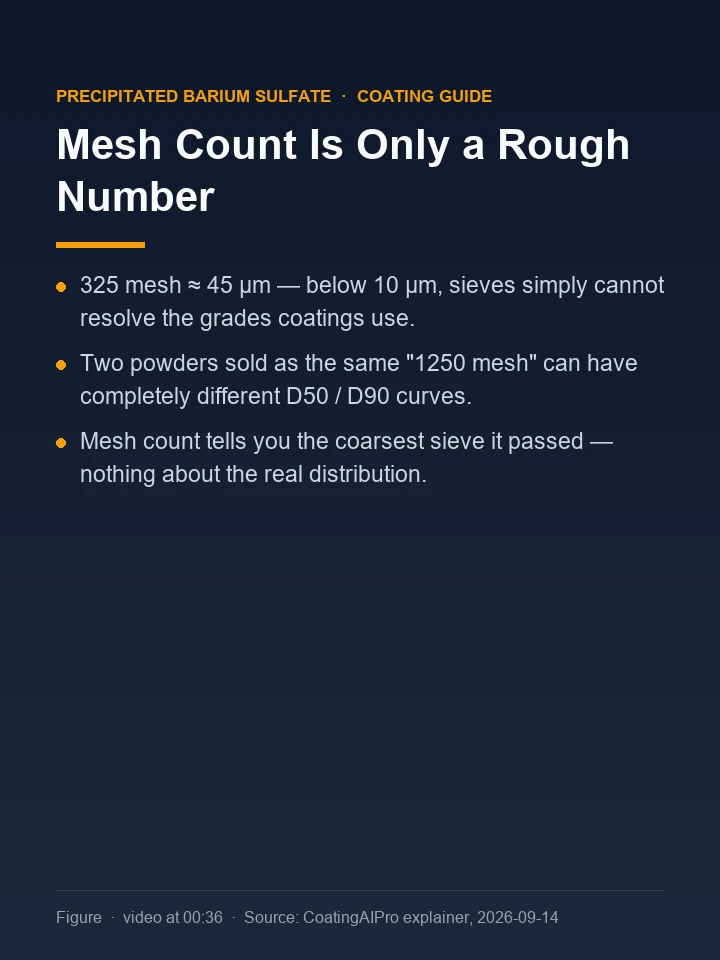
Mesh count comes from sieving. It expresses the number of openings per inch of screen wire: the higher the mesh, the smaller the opening. A 325-mesh screen has a nominal opening of about 45 µm (44 µm average opening per NIST reference data, 45 µm nominal per ASTM E11 / ISO 3310-1 sieve series). For coarse powders and traditional mineral fillers, this is a meaningful statement: it tells you the powder has largely passed a particular screen.
The problem is what mesh cannot say. Passing 325 mesh only proves that oversized particles are below roughly 45 µm. It cannot distinguish a powder whose D50 is 1 µm from one whose D50 is 5 µm or 15 µm, and it cannot tell you whether D90 is 3 µm or 30 µm. Modern coating performance is extremely sensitive to exactly that 1–10 µm window, where sieving offers no resolution at all.
Why Sieving Breaks Down Below 10 Microns
When precipitated barium sulfate enters the 0.1–10 µm fine range, screening stops producing useful information. So-called "1250 mesh", "3000 mesh" and "5000 mesh" labels are often commercial claims rather than measured values. They do not substitute for a real particle size distribution.
Sieving also suffers from two physical biases in fine powders. First, particle shape: a plate-like or flaky particle can pass flat through a screen, or be retained edge-on - the same particle gives different results depending on orientation. Second, electrostatic agglomeration: fine powder tends to charge and cling, clogging the screen and inflating measurement error. Both effects make sieve results poorly reproducible exactly where coatings need precision.
Particle Shape and the "Equivalent Spherical Diameter"

Real precipitated barium sulfate particles are rarely perfect spheres. They can be near-spherical, but also plate-like, tabular, ellipsoidal - or clusters of primary particles held together as agglomerates. Laser diffraction converts all of these irregular shapes into an "equivalent spherical diameter": the diameter of a sphere that scatters light in a similar way. ISO 13320:2020, the international standard for laser diffraction particle size analysis, formalizes this approach and covers measurement from roughly 0.1 µm up to 3 mm.
The equivalent sphere is not a claim that particles are round. It is a comparable scale that lets formulators compare different batches, suppliers and dispersion states on the same continuous axis - something a single sieve opening can never provide. Without it, two powders both called "fine" may have completely different real dispersed units.
D50: A Useful Center - But Never a Release Criterion
D50 is the median particle size: the size at which the cumulative distribution reaches 50%, meaning half the particles are smaller and half are larger. In a formulation, D50 is the natural first read on a powder - is this barium sulfate sub-micron, micron-range, or a coarser filler?
As D50 decreases, the number of particles per unit mass increases, total surface area rises, and the demand for wetting agents, dispersants and resin changes. D50 is therefore the first entry point for formulation calculation and incoming material approval. But it is a central-tendency number: it should anchor a judgment, not stand alone as a release criterion.
The Real Blind Spot: D50 Ignores the Distribution Tails
Two barium sulfate samples can both have a D50 of 1 µm and behave completely differently in the field. One sample is tight, with D90 at 3 µm; the other contains coarse particles or agglomerates pushing D90 to 8 µm. Their average fineness looks identical, but their high-gloss, thin-film and spray-filtration behavior differs sharply.
A formulator who watches only D50 hides the coarse-tail risk - until the film turns hazy, rough or settles. Many complaints are not caused by the average particle at all; they are caused by an uncontrolled coarse tail.
D90: The Upper-Tail Protection Line

D90 is the size at which the cumulative distribution reaches 90%: 90% of particles are below it and 10% above. It is not the maximum particle size, but it is the practical upper-tail control point in formulation.
Coating defects are rarely caused by average particles. They are caused by a small number of large particles, hard agglomerates or undispersed particles. Loss of gloss, surface bumps, nozzle spitting, filter clogging and hard settling are all associated with an elevated D90. In high-requirement systems, D97 or the maximum particle is sometimes checked as well.
Laser diffraction instruments commonly report a volume distribution, which is especially sensitive to coarse particles. Because particle volume scales with the cube of diameter, even a few coarse particles contribute disproportionately to volume and mass. A sample with D50 = 1 µm and D90 = 8 µm has a very broad coarse tail - and for high-density barium sulfate, those coarse particles settle faster too. Reading D90 is not about chasing a pretty number; it is about catching, in advance, the big problems that a few particles can create.
D10 and Span: Describing the Width of the Distribution
D50 and D90 alone are not complete. D10 marks the fine end. Span - usually (D90 − D10) / D50 - describes the width of the distribution.
A small Span means a narrow distribution: particles cluster around the center. A large Span means the fine and coarse ends are pulled far apart. In coatings, narrow distributions generally give more stable gloss and more uniform film formation. A moderately wide distribution can sometimes improve packing and filling - but it also raises the risk of settling, roughness and stratification. The right width depends on the application target: high-gloss systems and powder topcoats usually fear wide distributions most.
The Fundamental Problem with Mesh Count
Mesh count reports information about one sieve opening only. All powders "passing 325 mesh" share just one fact: coarse particles are under about 45 µm. That tells you nothing about whether D50 is 1 µm, 5 µm or 15 µm, nor whether D90 is 3 µm or 30 µm - precisely the range to which modern coating performance is most sensitive.
Switching from mesh to D50/D90 for precipitated barium sulfate is an information upgrade: it creates a traceable relationship between the raw material specification and film performance, and it removes vague language from supplier communication.
Density, Stokes' Law, and Storage Stability

Precipitated barium sulfate is dense - roughly 4.3–4.5 g/cm³, with published reference values around 4.4–4.5 g/cm³ (compared with resin and water at ~1.0, titanium dioxide at ~4.2, and ground calcium carbonate at ~2.7). That density is valuable: it supports stable filling, higher film density and improved chemical resistance. But it also drives sedimentation.
Sedimentation follows Stokes' law: under laminar conditions, the settling velocity of a particle is proportional to the square of its diameter and inversely proportional to liquid viscosity (v = Δρ·g·d² / 18η). The squared relationship is punishing. A 10 µm particle settles roughly 100 times faster than a 1 µm particle. So although coarse-tail particles are a minority, they decide whether a hard sediment forms at the bottom of the can. Thickeners and anti-settling agents help, but if D90 is too high, back-end rheology alone usually cannot rescue the system.
Storage testing should therefore examine whether the sediment is soft and re-dispersible - not just whether separation occurred.
High-Gloss Systems: Why D90 Often Matters More Than D50

Gloss comes from specular reflection on a smooth surface. If particles protrude from the film or create micro-roughness, diffuse reflection increases and gloss falls. What matters is not how fine most particles are, but whether a few coarse particles exceed the film thickness that can encapsulate them. With dry film thicknesses of only 20–30 µm, a coarse particle of just a few microns can affect the surface. High-gloss thin-film systems must control D90 strictly - D50 alone is not sufficient. When gloss fluctuates, the coarse tail should be the first suspect, with surface profilometry and micrographs as follow-up evidence.
Fineness Is a Double-Edged Sword: Surface Area, Oil Absorption and Viscosity

Smaller D50 means more surface area per unit mass. Wetting and dispersion become harder; more resin, solvent and dispersant are consumed; viscosity and oil absorption rise. In waterborne systems, very fine particles can amplify competitive adsorption among thickeners, wetting agents and defoamers. Fine is not unconditionally better.
High-gloss systems need fineness, and anti-settling systems want a small coarse tail - but if D50 is over-fined, the paint becomes hard to disperse, hard to level, and viscous, narrowing the application window. Solids content and additive levels must be adjusted together.
Oil absorption is a practical formulation metric: how much oil or resin phase is needed to wet the powder to a given state. Finer barium sulfate has higher specific surface area and typically higher oil absorption. Higher oil absorption consumes more resin at the same addition level, reducing free resin, raising viscosity, and hurting gloss and leveling. D50 helps predict the oil absorption trend; D90 hints at whether a coarse fraction is changing packing and local encapsulation. When replacing one grade with another, do not substitute by equal mass - recalculate PVC, resin content and dispersant dosage.
CPVC and Pigment Packing: The Role of Particle Size

The critical pigment volume concentration (CPVC) - the PVC at which binder just fills the voids between pigment particles, above which film properties change markedly (ISO 4618 definition; concept introduced to the coatings industry by Asbeck and Van Loo) - depends on pigment packing and binder coverage.
With a narrow size distribution, particles are more uniform and maximum packing can be lower. A moderately wide distribution lets fine particles fill voids between coarse particles, improving packing efficiency. But if the distribution is too wide, coarse particles may lack sufficient resin around them, while fine particles raise oil absorption - ending in voids, loss of gloss, or reduced water resistance. D50 governs average specific surface area; D90 governs the coarse tail and packing width. Together they shape CPVC and resin demand. Formulations operating near CPVC are especially sensitive to batch-to-batch particle size variation.
Refractive Index and the Titanium Dioxide "Spacer" Role

Precipitated barium sulfate has a refractive index around 1.64 (published values 1.63–1.65, e.g. 1.636/1.637/1.648), higher than most resins but far below titanium dioxide at roughly 2.7. It cannot provide high hiding power on its own. In white and light-shade systems, its value is as a regulator and filler: it spaces titanium dioxide particles, increases film density and controls cost.
Titanium dioxide scatters light most efficiently when particles are about 0.2–0.3 µm in diameter - slightly less than half the wavelength of yellow-green light (0.55 µm), as documented in the Ti-Pure (formerly DuPont) technical literature on titanium dioxide for coatings. When TiO₂ particles sit too close together, crowding reduces scattering efficiency per unit pigment. Fine precipitated barium sulfate can enter the gaps between TiO₂ particles, spacing them and distributing the pigment more evenly.
Particle size matching here relies on D50 and D90. If barium sulfate D50 is too coarse, the spacing is too crude; if D90 is too large, coarse particles crowd the useful space, adding roughness and local hiding variation. In white paints, the barium sulfate size curve should be examined side by side with the titanium dioxide curve. Positioning barium sulfate as a hiding-pigment substitute usually misreads the formulation; the more accurate role is serving TiO₂ efficiency and film structure.
Colored Systems: Color Strength, Chroma and the Tail
In colored coatings, particle size affects color strength and chroma. Fine, uniform barium sulfate helps pigment distribution stay stable and colors stay clean. When D90 is elevated, coarse particles can cause local haze, graying, roughness or color difference during film formation. In carbon black and organic pigment systems, over-fine fillers raise oil absorption and dispersant competition, potentially lowering color strength.
Colored systems therefore cannot simply chase maximum fineness. D50, D90, dispersant matching and the final hue must be evaluated together. Dark high-gloss systems are especially sensitive, because even slight roughness amplifies a gray haze.
Gloss vs. Matte Finishes: Using D90 on Purpose
High-gloss systems push D90 down, but matte systems sometimes use larger particles to create surface micro-roughness and lower gloss. In that case D90 is not only a risk indicator - it is part of the matting design.
The catch: precipitated barium sulfate is not a highly efficient matting agent like porous diatomaceous silica. Its matting capability is limited, and an overly wide distribution can produce mottling, rough feel, local bright spots or settling. Matte formulations must balance matting efficiency against surface uniformity; uncontrolled coarse tails are not matting. An even matte finish is harder than a merely low-gloss one - it requires a controlled distribution.
Grinding and Dispersion: D90 as a Diagnostic Signal

During milling and dispersion, D90 is a sensitive diagnostic. The raw material may have a fine D50, but if wetting is insufficient, the dispersant is mismatched, or shear is inadequate, fine particles remain as agglomerates and D90 rises. Sometimes D50 changes little while D90 drops from 7 µm to 2 µm - that drop is the signature of coarse agglomerates being opened. Conversely, a D50 that passes with D90 still elevated signals hard agglomerates or residual coarse particles. In formulation development, record D90 before and after dispersion, and re-test after heat storage to detect re-agglomeration.
When D90 is elevated, the common reflex is to grind longer. But dispersing precipitated barium sulfate depends not only on time but on wetting agents, dispersant type, resin polarity, milling media and slurry solids. Soft agglomerates can be broken by shear; hard agglomerates may require a different dispersion system. Over-grinding brings temperature rise, foaming, additive imbalance - and can re-flocculate fine particles. A more robust practice is to judge dispersion by D50, D90 and viscosity together, rather than by a single Hegman gauge reading, which cannot see the full distribution and easily misses a small coarse tail.
Spraying and Filtration: Protecting the Shop Floor

Spraying and filtration care most about coarse particles. High-gloss topcoats, industrial topcoats and precision coating lines often pass through filter bags or cartridges. Barium sulfate with an elevated D90 clogs filters, causes bumps and uneven spray patterns. Nozzles are sensitive to hard particles and agglomerates; and because barium sulfate is dense, coarse particles deposit easily in circulating lines. A beautiful D50 does not guarantee smooth application. Specifications that state D90 or D97 protect shop-floor performance far better than a mesh number. Comparing particle size before and after filtration also reveals whether coarse agglomerates are being retained.
Powder Coatings: The Full Size Distribution Matters

In powder coatings, particle size distribution affects fluidization, transfer efficiency, electrostatic spraying, melt flow and film smoothness. As a filler in powder systems, precipitated barium sulfate's D50 and D90 influence dry-blend uniformity before extrusion and particle arrangement in the melt. Powder coatings generally favor a narrow distribution: a low D90 supports surface quality, and an appropriate D10 improves powder flow while reducing ultra-fine dust problems. Mesh is even less useful here, because powder coatings care about the complete grading curve - an elevated coarse tail can leave particle streaks during melt flow, and the coarse fraction should be re-checked after extrusion dispersion.
Plate-Shaped Grades: When "Equivalent Sphere" Is Not Enough
Some precipitated barium sulfate grades are not near-spherical but plate-like or tabular. For these, the laser-diffraction D50 and D90 are equivalent spherical diameters that mostly reflect the lateral dimension of the plates, not necessarily the plate thickness. The aspect ratio of plate-shaped particles affects barrier performance, gloss, rheology and orientation.
Sieving distorts plate-shaped particles even more, because a plate can pass flat through an opening. When selecting plate-shaped barium sulfate, look beyond D50 and D90: add microscopy of morphology, aspect ratio, oil absorption and post-dispersion state. Plate-shaped materials behave more like structural fillers and should not be judged as spherical powders.
Same D50, Different D90: A Concrete Example
Take two precipitated barium sulfate samples, both with D50 = 1 µm. Sample A has D90 = 2.8 µm; sample B has D90 = 8.5 µm. In a 25 µm dry-film high-gloss waterborne acrylic topcoat, sample A is more easily and completely encapsulated by resin - a smooth surface and stable gloss. Sample B, despite the identical median, produces micro-bumps, haze, settling and filtration risk.
The example is the whole argument in miniature: identical D50 does not mean identical material. D90 is what exposes the coarse-tail defect. On-site evaluation should put dry film thickness and D90 on the same scale.
The D90/D50 Ratio as a Batch Warning Signal
The D90/D50 ratio gives a fast read on whether the distribution is being stretched by its coarse tail. D50 = 1 µm with D90 = 3 µm gives a ratio of 3; D90 = 9 µm gives a ratio of 9. The latter signals a pronounced coarse tail with greater dispersion, settling, gloss and filtration risk.
The ratio alone cannot judge good or bad - some low-gloss or highly filled systems intentionally use a moderately wide distribution to improve packing. The key is to read the ratio in the application context: high-gloss thin films want narrow; highly filled systems can tolerate wider. Ratio drift is also a useful batch-to-batch warning.
How to Write a Professional Specification
A specification that only says "superfine precipitated barium sulfate" or "1250 mesh" cannot guarantee batch stability. The professional way is to constrain D10, D50, D90 and, where needed, Span. Example: D50 controlled at 0.8–1.2 µm, D90 not above 3.5 µm, D10 not below 0.3 µm. This constrains the center, the fine end and the coarse end at once, making gloss, viscosity, dispersion and storage stability comparable between batches. For a coatings plant, this is far more useful than mesh: the clearer the acceptance standard, the easier it is to trace formulation drift.
Replacing Suppliers or Batches: Always Watch the Tail

Two products both labeled "precipitated barium sulfate" can differ widely in D50, D90 and oil absorption because of different processes and surface treatments. Replacement decisions should not rest on whiteness, price and mesh alone. A more robust protocol: measure the dry powder size first, then the dispersed slurry size; record viscosity, fineness, gloss, hiding, settling and filtration behavior.
If D50 is similar after a switch but D90 rises, the problem may not appear in small-sample appearance - it surfaces after scale-up, application and storage. Raw material substitution must watch the coarse tail. When a supplier changes batches, keep the particle size curves for traceability, so an anomaly can be assigned to raw material or process rather than guessed at.
Waterborne vs. Solvent-Borne Systems: Context Changes Everything
Waterborne coatings are especially sensitive to barium sulfate particle size distribution. The water phase contains dispersants, wetting agents, thickeners, defoamers, pH adjusters and emulsion particles - any of which can change surface adsorption on the particles. An over-fine D50 raises additive demand and viscosity; an elevated D90 brings settling and roughness. Associative thickeners can even bridge particles and emulsion droplets, changing low-shear rheology.
For waterborne acceptance, check the dispersed D90 and the particle size rebound after heat storage. If D90 rises after heat storage, the stabilization layer may be weak - an earlier signal than viscosity change alone.
In solvent-borne systems, particle size affects resin wetting, slurry flow and dry-film encapsulation. With sufficient resin polarity and solvent solvency, particles wet well and D90 risk falls; with poor resin affinity, coarse particles and agglomerates become defect nuclei. In high-solids systems, free solvent is scarce, so a finer D50 quickly raises viscosity. In thin-film topcoats, a larger D90 directly sacrifices gloss. Solvent-borne formulations cannot use mesh as a substitute for size distribution either - and when resin wetting is weak, changing the dispersion system beats blind grinding.
A Six-Check Screening Protocol for Small Samples

When screening a precipitated barium sulfate sample, six checks cover the decision space:
1. **Raw material D10, D50, D90 and Span** - the distribution itself.
2. **D90 after dispersion** - does it drop, confirming agglomerates are opened?
3. **Slurry viscosity and thixotropy** - any anomaly?
4. **60° or 85° gloss and surface fineness** - the visible outcome.
5. **Settling and re-dispersion after storage** - soft sediment or hard pack?
6. **Filtration, spraying and dry-film defects** - the shop-floor outcome.
One mesh number or one D50 cannot cover these. Useful particle size control must map to formulation performance one-to-one; only then does a selected grade survive scale-up. Test with the same resin and the same dispersion process for comparability.
Precipitated barium sulfate is not "the finer, the better". Lowering D50 improves fineness, gloss and dispersion uniformity, but raises surface area, oil absorption, viscosity and additive demand. Lowering D90 reduces roughness, settling and filtration risk, but an over-narrow distribution can reduce packing efficiency in some highly filled systems. Judge from the target: high-gloss topcoats prioritize D90; thick pastes and cost-driven filling balance packing; waterborne systems also watch additive compatibility.
Conclusion: Move from Mesh Count to a Traceable Loop

D50 and D90 of precipitated barium sulfate cannot substitute for each other. D50 tells you where most particles sit - driving surface area, oil absorption, dispersant demand and filling efficiency. D90 tells you how large the coarse tail is - driving gloss, roughness, settling, filtration and spray defects. Mesh provides only a coarse sieve-level label and cannot describe a micron-scale distribution.
A mature formulation does not ask "how many mesh is this barium sulfate?" It asks whether the D50, D90, Span and post-dispersion state fit the current coating. Asking that question correctly moves raw material selection into formulation language - and gives gloss, settling and application problems a real entry point for troubleshooting. The more specific the specification, the fewer problems on the shop floor. Keeping the particle size curve is keeping the evidence - traceability makes formulations stable.
Sources & Further Reading
- ISO 13320:2020, *Particle size analysis - Laser diffraction methods* - https://www.iso.org/standard/69111.html - ASTM E11 / ISO 3310-1 nominal sieve openings (No. 325 ≈ 45 µm) - https://meshcalculator.com/zh/tools/mesh-count-conversion/ ; NIST *Sieve Test of Metal Powders* (325 mesh average opening 44 µm) - https://nvlpubs.nist.gov/nistpubs/jres/39/jresv39n6p487_A1b.pdf - Precipitated barium sulfate physical data: relative density ≈ 4.50 (15 °C), refractive index 1.63–1.65 (1.636/1.637/1.648) - Douyin Baike (沉淀硫酸钡) https://m.baike.com/wiki/%E6%B2%89%E6%B7%80%E7%A1%AB%E9%85%B8%E9%92%A1/3909438 ; ECHEMI BaSO₄ product reference https://www.echemi.com/produce/pr2411061343-high-purity-barium-sulphate-precipitated-baso4-cas-7727-43-7.html - Stokes' law and sedimentation in coatings (v = Δρ·g·d²/18η) - MICROTRAC, *Sedimentation in the Coating Industry* - https://www.microtrac.com/knowledge/sedimentation-in-the-coating-industry/ - ISO 4618, *Paints and varnishes - Terms and definitions*: CPVC definition - https://www.iso.org/obp/ui/fr/#iso:std:iso:4618:ed-1:en:clause:2.103 ; Asbeck & Van Loo, *Coalescence and Film Formation from Latexes* (American Coatings Association) - https://www.paint.org/wp-content/uploads/2021/09/jctFEB96-Hoy.pdf - Ti-Pure™ (formerly DuPont), *Titanium Dioxide for Coatings*: optimum TiO₂ particle size 0.2–0.3 µm - https://www.tipure.com/en/-/media/files/tipure/legacy/titanium-dioxide-for-coatings.pdf
*This article is adapted from a technical explainer video by CoatingAIPro on precipitated barium sulfate selection , supported by Yunfu Hongzhi New Materials Co., Ltd. Technical content follows the video's explanation order; supplementary background data are cited to the sources listed above.*