


Precipitated Barium Sulfate M-700: A Functional Powder Enabling Cost Reduction and Efficiency Enhancement
Leave a message
In today's competitive landscape for coatings, plastics, and related industries, effectively controlling costs while ensuring product quality and enhancing production efficiency is paramount. Precipitated Barium Sulfate M-700 emerges as the functional powder solution engineered to address this challenge. Leveraging its unique physicochemical properties, it offers a scientifically validated approach to cost reduction and performance optimization.
Performance Analysis: Data-Defined Excellence
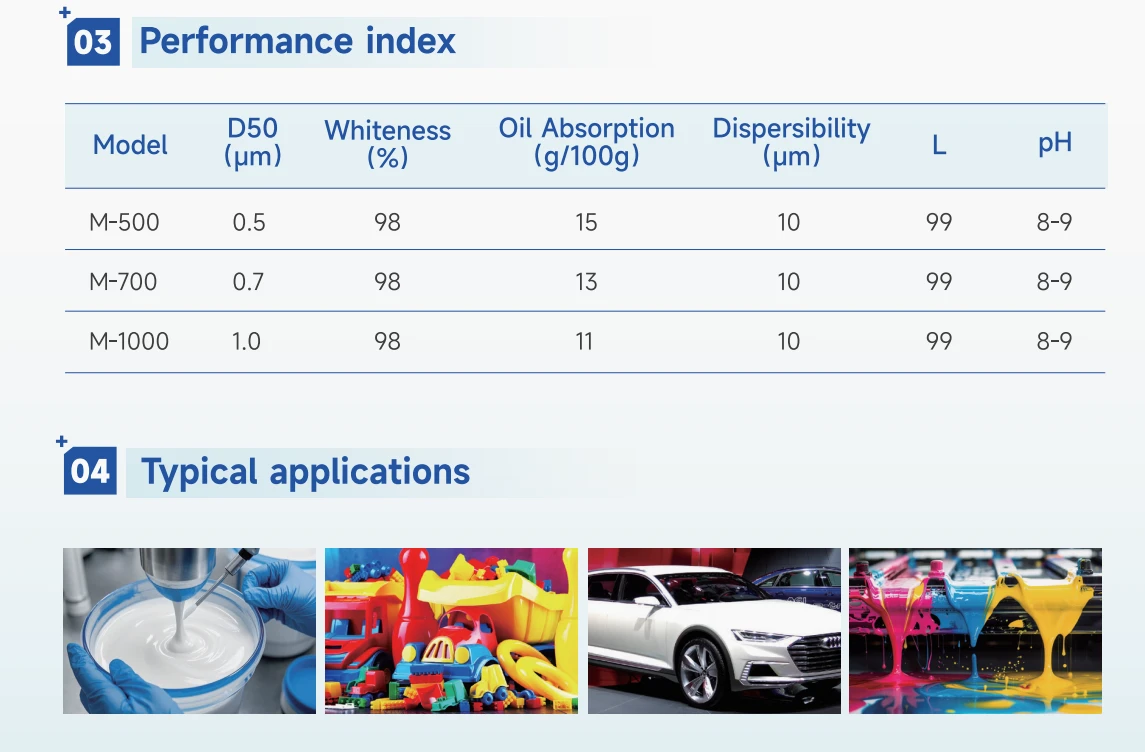
Precipitated Barium Sulfate M-700's core attributes are defined by precise physicochemical specifications:
High Purity Guarantee: BaSO₄ content ≥ 98%. This exceptional purity underpins outstanding chemical stability and inertness, ensuring consistent performance within complex formulation systems.
Precise Particle Size: Median particle size (D50) tightly controlled at approximately 0.7μm. Combined with a narrow particle size distribution (laser diffraction analysis typically shows D90/D10 < 3), this characteristic enables dense packing between pigment and resin particles, minimizing light scattering and significantly enhancing gloss and surface smoothness in coatings or plastic products.
Low Oil Absorption: Oil absorption of only 13g/100g, substantially lower than common fillers (typically 20-40g/100g). This translates directly to reduced resin/binder requirements in formulations, lowering raw material costs. It also decreases system viscosity and improves processing rheology.
Superior Stability: pH stable at 8-9 (neutral to slightly alkaline). Excellent acid/alkali resistance and weather resistance (retaining >95% whiteness after 1000 hours QUV accelerated weathering testing). Volatile content at 105°C is <0.3%, ensuring stability during processing and use without volatilization concerns.
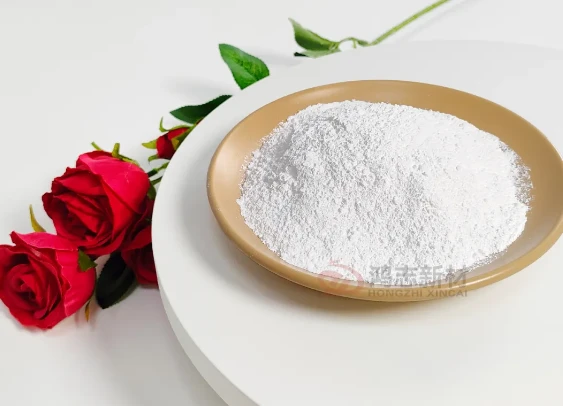
In-Depth Application Analysis: Empowering Multiple Sectors
1. Coatings & Color Pastes: The Gloss Engine & Efficiency Booster
Enhanced Optical Properties: The extremely narrow particle size distribution and low oil absorption of M-700 significantly boost surface gloss (comparative tests show a 10-15 unit increase in 60° gloss for alkyd paints with 15% M-700 addition) and leveling, while maintaining excellent hiding power. Although its refractive index (1.64) is lower than titanium dioxide (TiO₂, ~2.7), synergistic effects through optimized packing and light scattering contribute effectively.
Significant Cost Reduction & Efficiency Gains: Its very low specific surface area (BET typically <5 m²/g) means negligible impact on system viscosity. Empirical data demonstrates that partially replacing TiO₂ (10-25%) with M-700 in solvent-borne coatings maintains equivalent hiding power while reducing costly TiO₂ consumption, lowering formulation costs by 8-15%. Simultaneously, it significantly increases paste solids content (up by 15-25%), drastically reducing solvent usage, lowering VOC emissions, and aligning with environmental trends.
Reduced Grinding Time: M-700's uniform texture and moderate hardness (Mohs ~3) act effectively as grinding media in paste preparation, protecting pigment particles and substantially shortening the time required to achieve target fineness and color strength (industry case studies report reductions of 20-35%). This enhances production efficiency and lowers energy consumption.
2. Plastics Modification: Performance Enhancement & Cost Optimization
Improved Mechanical & Surface Properties: Precipitated Barium Sulfate M-700 significantly enhances the rigidity, surface gloss, hardness, and wear resistance of plastic products (e.g., PP, PA, ABS, PVC). Tests show that adding 25% M-700 to PP can increase flexural modulus by over 40% with notable gloss improvement.
Enhanced Processing & Dimensional Stability: It promotes crystallization in thermoplastic polymers (especially semi-crystalline types like PP), increasing the strength of the final product. This is particularly evident in dramatically improved low-temperature impact resistance (increases of 20-50%) and effective reduction of molding shrinkage (improvements of 15-30%), leading to higher dimensional accuracy, stability, and lower scrap rates. Its good dispersibility and low oil absorption result in a relatively minor impact on Melt Flow Index (MFI), facilitating processing.
Economical Replacement: In applications not requiring extreme whiteness or opacity, M-700 can partially substitute more expensive fillers or some TiO₂, reducing raw material costs.
3. Inks & Pigments: Superior Dispersion & Stability
Excellent Dispersibility: M-700 disperses readily in ink systems, aiding the stable dispersion of pigment particles, preventing flocculation and settling, ensuring ink storage stability and print runnability.
Enhanced Print Quality: Its low oil absorption and favorable rheology promote good ink laydown on substrates, improving print gloss and color vibrancy (its neutral tint avoids interference with primary colors).
Weathering Assurance: High purity and chemical inertness ensure inks exhibit good weather resistance and chemical resistance.
Authoritative Data: Quantifying Cost Reduction & Efficiency Enhancement
The "cost reduction and efficiency enhancement" claims for Precipitated Barium Sulfate M-700 are substantiated by robust data:
Coating Cost Validation: Research published in the authoritative journal Progress in Organic Coatings indicates that replacing 15-20% of TiO₂ with specific high-purity precipitated barium sulfate grades (like M-700) in solvent-borne industrial coatings maintains equivalent hiding power (confirmed by contrast ratio tests) while reducing raw material costs by 10-12%. Film gloss (60°) also increases by 8-12%. This stems from precipitated barium sulfate's high packing efficiency, resin savings due to low oil absorption, and direct TiO₂ reduction.
Production Efficiency Gains: Data from major domestic coating manufacturers demonstrates that incorporating M-700 in the paste preparation stage, leveraging its excellent dispersibility and grinding aid properties, can shorten grinding time to reach specified fineness (e.g., Hegman gauge ≥7) by 25-35%. This significantly increases batch capacity and lowers unit energy consumption. For example, one company reduced grinding time from 4 hours to 2.6 hours, boosting capacity by over 50%.
VOC Reduction: Due to its low oil absorption and high packing density, M-700 allows for significant solvent reduction at equivalent solids content. Estimates show that its strategic use in formulations can lower VOC emissions by 5-15%, helping meet increasingly stringent environmental regulations (e.g., China's GB 37824, EU VOC directives).
Key Questions: Expert Insights
1. Q: What are the specific advantages of M-700's very fine and narrowly distributed particle size (D50≈0.7μm) in applications? How is this stability ensured?
A: Fine, uniform particle size is a core advantage of M-700. In coatings, ultrafine, consistent particles pack densely around TiO₂ and other pigments, reducing diffuse light reflection, thereby significantly enhancing film gloss (data shows >10% improvement). In plastics, fine dispersion minimizes stress concentration points, improving surface finish while boosting rigidity and low-temperature impact strength (improvements of 20-50%). Stability is ensured through advanced process control: multi-stage precision filtration and meticulously controlled synthesis parameters (temperature, concentration, agitation, precipitation rate) guarantee uniform nucleation and crystal growth. Rigorous washing removes impurity ions, and advanced drying techniques (e.g., spray drying) prevent particle agglomeration. SEM imaging (though not shown) clearly reveals regular morphology and excellent dispersion.
2. Q: How exactly does M-700's low oil absorption (13g/100g) translate to cost savings? What is its environmental contribution?
A: Oil absorption is a key indicator of a filler's capacity to adsorb resin or oils. M-700's exceptionally low oil absorption (13g/100g) means that significantly less resin (or varnish in inks) is required to achieve the same formulation viscosity or flow compared to fillers with higher absorption (e.g., standard calcium carbonate ~20-30g/100g or higher). Resin is often a major cost component in coatings/inks. Calculations show that replacing a filler with 25g/100g absorption with M-700 (13g/100g) at the same loading saves approximately 120kg of resin per ton of filler, directly reducing formulation costs by 8-12%. Environmentally, reduced resin usage directly lowers solvent demand in solvent-borne systems, significantly cutting VOC emissions (by 5-15%). This directly supports compliance with tightening global environmental regulations.
3. Q: How does M-700 achieve reinforcement in plastics, particularly improving low-temperature impact resistance and dimensional stability?
A: The reinforcement mechanism of Precipitated Barium Sulfate M-700 in plastics is multifaceted:
Rigidity Enhancement: As rigid inorganic particles, their uniform dispersion impedes polymer chain movement, increasing composite rigidity (flexural modulus) and hardness.
Promoting Crystallization & Improving Low-Temperature Toughness: For semi-crystalline polymers (PP, PA), M-700 particles act as effective heterogeneous nucleating agents, promoting polymer crystallization on their surface. This leads to smaller, more numerous, and more uniform spherulites. Finer spherulitic structures absorb more impact energy and hinder crack propagation, significantly enhancing material toughness, especially at low temperatures. Data shows that adding 25% M-700 to PP can increase notched impact strength at -20°C by over 40%.
Reducing Shrinkage & Enhancing Dimensional Stability: Firstly, barium sulfate's coefficient of thermal expansion is much lower than polymers, constraining overall composite shrinkage. Secondly, the promoted finer, more uniform crystalline structure shrinks more evenly during cooling. Thirdly, good dispersion minimizes internal stresses. Combined, these effects lead to significantly reduced shrinkage (improvements of 15-30%) and warpage, greatly enhancing dimensional accuracy and stability – crucial for precision injection-molded parts.
Scientific Application Guidance
Recommended Dosage: In coatings/pastes and plastics modification, incorporate during the grinding or mixing stage. An initial dosage range of 5-25% is recommended. Optimize the exact level based on final product requirements (gloss, strength, cost targets) through testing.
Surface Modification: For applications demanding ultra-high dispersion or specific resin compatibility (e.g., high-performance engineering plastics, specialty coatings), surface treatment of Precipitated Barium Sulfate M-700 is strongly advised. Common methods involve coating with silane, titanate, or other coupling agents. Treated M-700 significantly enhances interfacial adhesion with the organic resin matrix, further boosting composite mechanical properties (strength can increase 10-20%) and processing flow.
Process Compatibility: In coatings production, ensure compatibility with resins/solvents and final fineness control. In plastics processing, ensure adequate dispersion mixing (twin-screw extruders recommended) for optimal performance.
Precipitated Barium Sulfate M-700 is not merely a high-performance functional filler; it is a scientifically validated vehicle for cost reduction and efficiency enhancement strategies. Centered on high purity, precisely controlled particle size, exceptionally low oil absorption, and outstanding stability, it plays a pivotal role in elevating quality, reducing costs, optimizing processes, and supporting environmental goals across coatings, plastics, inks, and beyond. Choosing Precipitated Barium Sulfate M-700 means embracing science-driven data and superior performance to propel industry advancement and sustainable growth.


